Can We Talk About Men Without Turning Them Into the Enemy? 🗣️🐷
Writer and performer Caitlin McEwan explores what writing a comedy about misogyny, masculinity and an unusually opinionated pig taught her about empathy, accountability and the conversations we're having about men.

It takes me barely any digging to find a Reddit post with almost 200 comments titled 'I'm so sick of men'. If you've spent any time online over the past few years, you could probably fill in the comments yourself: 'they're literally so entitled', 'they hide behind this nice guy facade, but really they're all trash', 'be careful, or you might wake the "not all men" brigade'. Reading their complaints, I have sympathy: these women have been ghosted, fed mixed messages and have the wind of living their entire lives under patriarchy at their backs. It's no wonder that they feel this angry and uncharitable. I have been them; if I'm really honest, sometimes I still am them, but I'm trying not to be. For one, because I've spent the last year writing a play that tries to approach our current cultural preoccupation with masculinity from an empathetic, female perspective. But also, while some men may sometimes be trash, I think that line of argument does none of us any good.
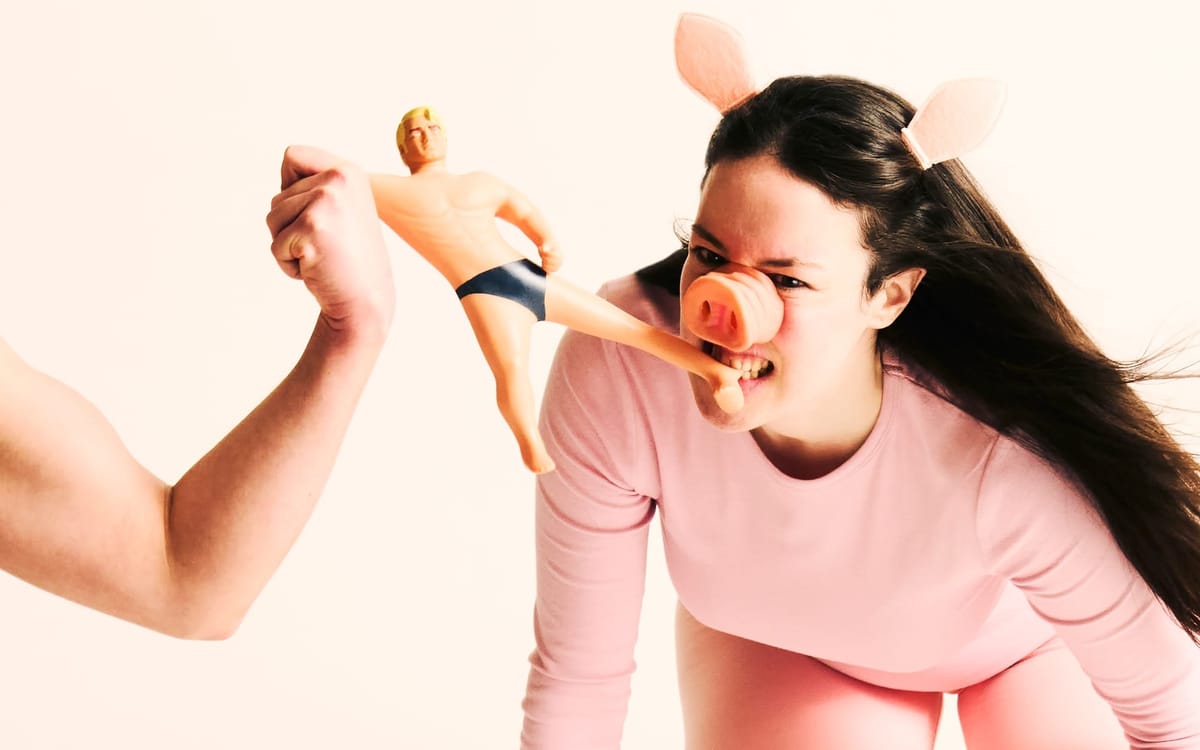
Two Little Pigs, which will be performed at the Edinburgh Fringe this August, is the story of Mark, who is dumped by his girlfriend, in no small part due to his controlling, misogynistic behaviour. His desperation for some companionship that won't talk back leads him to bring home a pet pig, complete with technology that will allow him to harvest her cells for meat. However, the pig is not quite the docile, pliable animal he was expecting. Penny (although that's not her chosen name, so don't even think about using it) learned English by eavesdropping on the young female farmhands who raised her, and is hoping to become the pet of a feminist socialist with a reality TV addiction, to whom she can ask all of her questions about the human world and the work of her favourite writer (who she's never read), Simone de Beauvoir. It's an absurd, odd-couple comedy about the thin line between humans and animals, and how we communicate across cultural and social divides.
The manosphere or its figureheads are never alluded to in the play, but their impact hangs over its events. The content Mark consumes online has hardened him to the women in his life who have hurt him. Consequently, he won't listen to them, but he will listen to Pig (who is played by the same actor as his ex-girlfriend) because of her removal from the human world. However, as the play goes on, he finds the dualities inherent in Pig difficult to accept: animal, but with human female characteristics; pet, and food source. It's hard to let her be both when he's become used to seeing things in black and white: red pill, blue pill. Women inferior, men superior.
While the audience will likely not be able to excuse some of Mark's behaviour in the play, my hope is that they understand and have empathy for him, even in his uglier moments. It was important to me that he didn't become a one-dimensional, misogynistic villain; I think that would have been an unhelpful flattening of the type of person who gravitates towards extreme content online. In a culture that discourages male vulnerability and seems to offer some men fewer opportunities than they have had in the past, it's no wonder that they look for deceptively simple answers to complex problems: women have taken your power. Be strong, grab that power back, and you can have whatever you want.
We're all looking for easy answers. Although they are on different sides of the fence, the women on Reddit who roll their eyes at egotistical, toxic f**kboys and the men who brand women intellectually inferior subjects are using similar rhetorical tactics. It's the same language used in internet pile-ons, which avoids nuance or thoughtful engagement in favour of point-scoring and crowd-pleasing, eviscerating put-downs. These might feel cathartic, but they don't solve anything; after all, 'men are trash' doesn't exactly help the many alleged victims of Andrew and Tristan Tate.
I don't have a road map out of this moment, but I am trying to employ empathy and understanding towards men like Mark wherever I can. That can be hard, especially when it feels like men are attacking or demeaning me personally, and it certainly doesn't mean condoning bad behaviour, especially when it's violent or dangerous. But I think it is more helpful than a pile-on in the long run.
We all have influence over our personal spheres, but I think there are cultural shifts that need to happen for us to make any meaningful progress, that can and should be led by men. I want to see more stories that confront the ugliest and most vulnerable parts of straight men's existence. Take the ghosting and mixed messages decried by the women of Reddit; when will men start dramatising the thought process behind that common pattern of behaviour? It would save the girls' group chats a lot of back-and-forth.
As with many, over the last six weeks, my social media has been full of content from the World Cup: as a Scot, I came for the heartwarming 'Tartan Army in Boston' videos, and stayed for the Erling Haaland Snapchat deep cuts and compilations of him hugging Jude Bellingham. Seeing men like Haaland be strong and soft, or powerful and silly, on a world stage, makes me think there's a way out of this dogmatic cultural moment. We just have to let them be both.
Caitlin McEwan is the writer and performer of Two Little Pigs, playing at Pleasance Courtyard at 7.45pm from 5th to 30th August as part of the Edinburgh Festival Fringe. Tickets are available via Pleasance.